







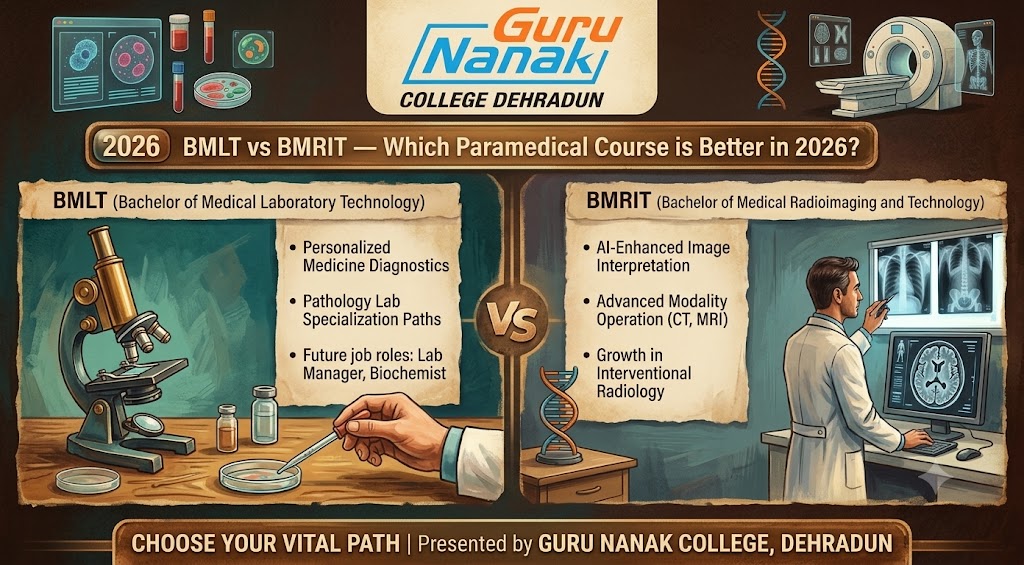
Choosing between BMLT (Bachelor of Medical Laboratory Technology) and BMRIT (Bachelor of Medical Radio Diagnosis & Imaging Technology) is one of the most common dilemmas for students exploring paramedical careers after Class 12. Both are in-demand healthcare programs at Guru Nanak College, Dehradun, but they lead to very different career paths.
Table of Contents
What is BMLT?
BMLT is a 4-year undergraduate program focused on diagnostic laboratory testing — blood analysis, microbiology, biochemistry, and pathology. BMLT graduates typically work in pathology labs, diagnostic centers, and hospital laboratories.
What is BMRIT?
BMRIT is a 4-year undergraduate program focused on medical imaging technologies — X-ray, CT scan, MRI, and ultrasound operations. BMRIT graduates work in radiology departments of hospitals and diagnostic imaging centers.
Key Differences — BMLT vs BMRIT
While both programs are 4 years long and require 10+2 with PCB, the day-to-day work differs significantly. BMLT is lab-based and involves sample analysis, while BMRIT is equipment-based and involves operating imaging machines and interacting directly with patients during scans.
| Factor | BMLT | BMRIT |
|---|---|---|
| Full Form | Bachelor of Medical Laboratory Technology | Bachelor of Medical Radio Diagnosis & Imaging Technology |
| Duration | 4 years | 4 years |
| Eligibility | 10+2 with PCB, min 45% marks | 10+2 with PCB, min 45% marks |
| Nature of Work | Lab-based — sample and diagnostic testing | Equipment-based — imaging machines and patient scans |
| Typical Workplace | Pathology labs, diagnostic centers, hospital laboratories | Radiology departments, diagnostic imaging centers |
| Patient Interaction | Limited — mostly sample handling | Direct — during imaging procedures |
| Career Growth | Specialized pathology and research roles | Senior imaging technologist and equipment specialist roles |
Salary Comparison
BMRIT graduates often start with slightly higher entry-level salaries due to the technical equipment skills required, but BMLT offers strong long-term growth into specialized pathology and research roles. At Guru Nanak College, paramedical graduates have seen placement packages up to ₹54.75 LPA in select national-level placements.
Which Should You Choose?
Choose BMLT if you enjoy lab work, sample testing, and detail-oriented analysis. Choose BMRIT if you're interested in medical imaging technology and prefer more direct patient interaction. Both are excellent, recession-proof healthcare careers with strong demand across India and internationally.
Why Study BMLT or BMRIT at Guru Nanak College?
Guru Nanak College, Dehradun offers both programs with modern labs, hospital tie-ups for clinical training, and a dedicated placement cell. With 100+ companies visiting campus and an average placement package of ₹12 LPA, GNC is among the best paramedical colleges in Dehradun and Uttarakhand.
→ Bachelor of Medical Laboratory Technology: https://gnc.edu.in/best-bmlt-college-in-dehradun
→ Bachelor of Medical Radio Diagnosis & Imaging Technology: https://gnc.edu.in/best-bmrit-bachelor-in-medical-radio-imagingtechnology-college-in-dehradun
→ All Paramedical Programs: https://gnc.edu.in/paramedical-college-in-dehradun-uttarakhand
Frequently Asked Questions
Both are excellent paramedical careers. BMLT suits students who enjoy lab-based diagnostic work, while BMRIT suits those interested in medical imaging technology and patient interaction. The 'better' choice depends on personal interest.
Both BMLT and BMRIT are 4-year undergraduate programs at Guru Nanak College, Dehradun.
Candidates must have passed 10+2 with Physics, Chemistry, and Biology (PCB) with minimum 45% marks.