






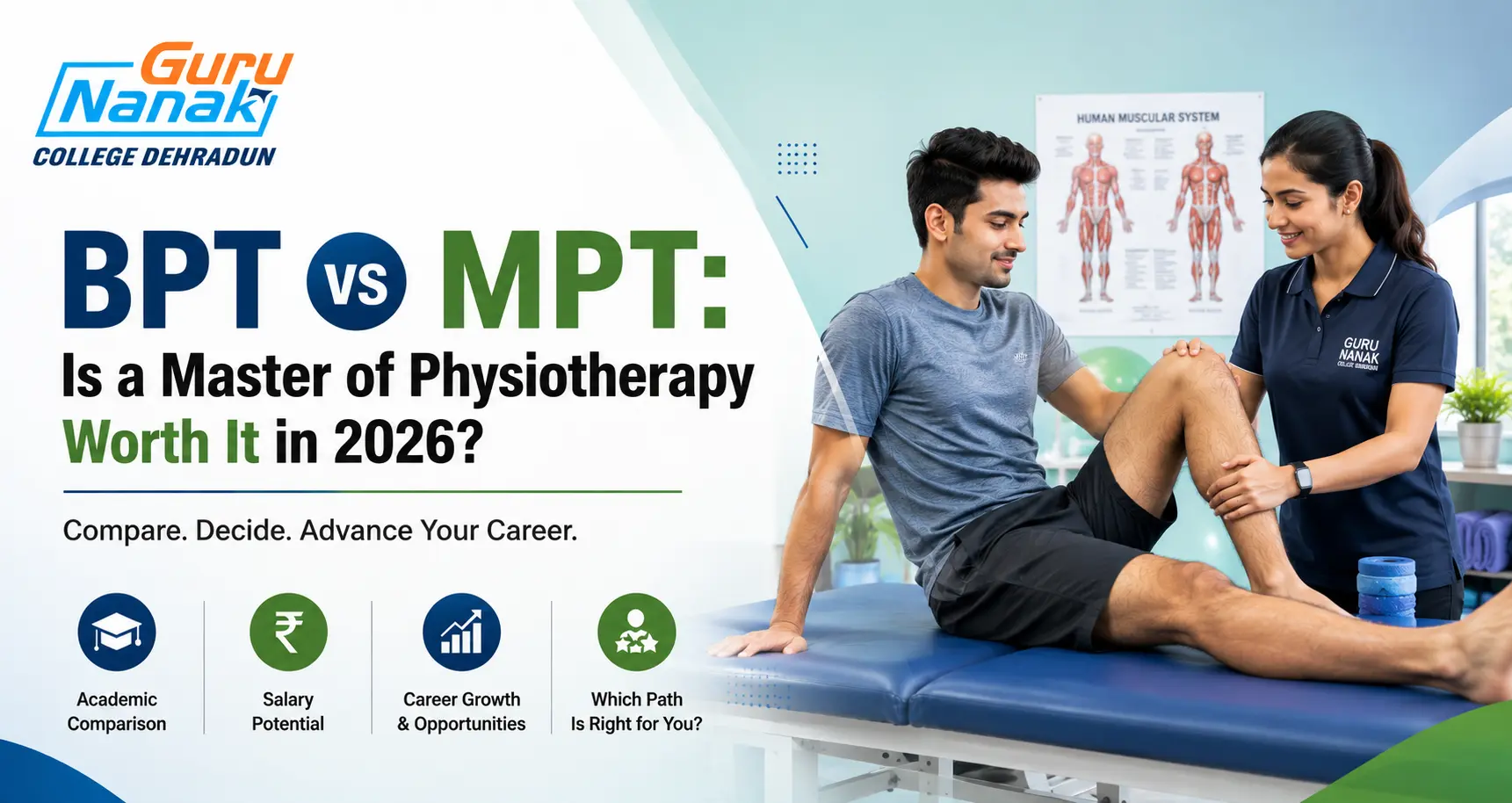
You have finished (or are about to finish) your Bachelor of Physiotherapy. Should you start working straight away, or invest two more years in a Master of Physiotherapy (MPT)? It is a fair question — and the answer depends on where you want your career to go. Let's compare the two clearly.
Table of Contents
BPT vs MPT: The Key Differences
A BPT is a four-and-a-half-year undergraduate degree (including internship) that qualifies you as a general physiotherapist. An MPT is a two-year postgraduate degree that builds advanced clinical expertise and lets you specialise in a focused area such as orthopedics, neurology or sports physiotherapy.
In short: a BPT makes you a physiotherapist; an MPT makes you a specialist. A BPT lets you treat a broad range of patients, while an MPT positions you to handle complex cases, lead rehabilitation teams, teach, and conduct research.
What You Gain With an MPT
- Specialisation and credibility. An MPT signals deep expertise in a chosen domain, which builds patient trust and referral networks.
- Higher earning potential. Specialists and senior physiotherapists typically command better pay than general practitioners.
- Career flexibility. An MPT opens roles in academia, research, rehabilitation consultancy and independent specialist practice that are difficult to access with a BPT alone.
- Leadership. Master's-trained physiotherapists are far better placed to lead multidisciplinary teams and rehab units.
When Is an MPT Worth It?
An MPT is worth it if you want to specialise, work with complex cases, move into teaching or research, or accelerate your long-term earning potential. If your goal is to be recognised as an expert — the physiotherapist others refer patients to — the two-year investment pays off over a full career.
If you simply want to start earning immediately and are happy in general practice, you can begin working with a BPT and pursue an MPT later. Many professionals do exactly this, returning for a master's once they know which specialty excites them most.
Career & Salary Outlook
Demand for physiotherapists is rising with lifestyle disorders, sports participation, road-accident rehabilitation and an ageing population. Within this growth, specialists stand out. Roles such as Senior Physiotherapist, Sports Physiotherapist, Neurological or Orthopedic Physiotherapist, and Rehabilitation Consultant generally offer stronger pay and progression than entry-level general roles — and an MPT is usually the gateway to them.
Why Do Your MPT at GNC Dehradun
If you decide an MPT is right for you, Guru Nanak College, Dehradun is a strong choice. The two-year program offers specialisation across ortho, neuro, sports, cardiopulmonary, pediatric and geriatric physiotherapy, backed by 12+ rehabilitation labs, 100% clinical practice, expert clinician-faculty and research exposure.
GNC also keeps postgraduate study affordable, with fees from Rs 65,000 per year and generous scholarships — merit waivers up to a full Tuition Fee Waiver, plus additional support for Uttarakhand domicile, sports, girl candidates, orphans and siblings, and the Kalpana Chawla Scholarship for top performers.
The Verdict
For students serious about a long-term career in physiotherapy, an MPT is worth it. It transforms a general practitioner into a specialist with better pay, more options and greater professional standing. The best time to specialise is when you are clear about the patients you want to help — and GNC Dehradun gives you the clinical exposure and support to make that leap with confidence.
Ready to Specialise?
Apply for the MPT program at Guru Nanak College, Dehradun.
Apply Online — Call 7300900900Frequently Asked Questions
A BPT is a four-and-a-half-year undergraduate degree (including internship) that qualifies you as a general physiotherapist. An MPT is a two-year postgraduate degree that builds advanced clinical expertise and lets you specialise in a focused area such as orthopedics, neurology or sports physiotherapy.
An MPT is worth it if you want to specialise, work with complex cases, move into teaching or research, or accelerate your long-term earning potential. If you simply want to start earning immediately, you can begin working with a BPT and pursue an MPT later.
GNC Dehradun offers specialisation across ortho, neuro, sports, cardiopulmonary, pediatric and geriatric physiotherapy, backed by 12+ rehabilitation labs, 100% clinical practice, expert clinician-faculty, research exposure, and affordable fees with generous scholarships.